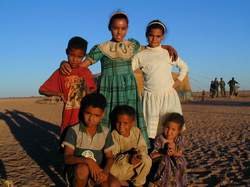
Origin of the Saharawi People
A mixture of indigenous Berbers and Arabic tribes the Saharawi peoples' direct ancestors can be traced back to the XVth century when tribes from the Yemen crossed North Africa establishing themselves in the region. The difficult environment conditions, cold dry winters, scorching summers, low irregular rainfall and rough terrain encouraged the different tribes to coexist and live together. Later the acceptance of Islam by the berbers and the increasing strength of the arabic culture gave the tribe's people a predominantly Arabic bias. As a result of this mixture of tribes the Saharawi people and culture was born.
Tribal Culture
In the Saharawi tribal culture no tribe exerted any direct or indirect power over any other and each one was represented in an overall governing body called the Assembly of Forty. Disputes were handled either in a friendly way or by compensation according to Islamic laws. More serious disputes were taken to the counsel of the chiefs of tribes, called Ait Arbein. To this day a similar organised structure exists in the administration of the refugee camps. Until the 1960s the Saharawi people were essentially nomadic pasturing cattle in the sandy low lying plains. They moved in accordance with seasons, their routes dictated by wells and watering holes. But during 1960s the Saharawi became increasingly sedentary. It was during this time that Saharawi nationalism grew in strength.
The Fact Box
- Population - 272,211 (July 1995)
- Population growth rate - 2.48%
- Birth rate - 46.9 births/1000 population
- Death rate - 18.52 deaths/1000 population
- Infant mortality rate - 148.95 deaths/1000 live
- Nationality - Sahrawi
- Ethnic Division - Arab, Berber
- Religion - Muslim
- Language - Hassaniayat Arabic, Moroccan Arabic
Life in Refugee Camps
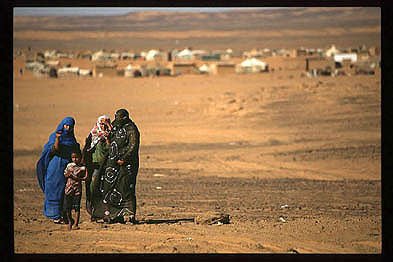
In 1975 Mauritanian force occupied the south and Moroccan forces to the north. The Saharawi people found themselves divided under the rule of their neighbours and by late 1975 tens of thousands had fled their homes to camps to the east of the region. As most of the men immediately joined the army it was the women, children and old people who fled to the refugee camps that had been set up on the eastern border. These camps were then bombarded with napalm and phosphorous and the refugees were forced to move on to the inhospitable desert of southwest Algeria. The refugees were organized initially into 3 camps each named after a town in W. Sahara; Smara (the sacred town), Dhakla (the largest port) and El Ayun (the capital). A 4th camp Awserd was formed later as a result of population growth. The refugee camps are located in the southwest Algerian desert around the oasis town of Tindouf.
Structure of the Camps
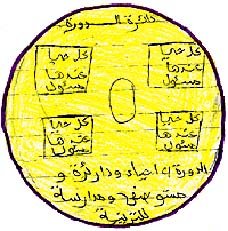
A drawing by one of the children in the El Ayun camp shows the structure of a typical daira (village) with its four hay (neighbourhood). Goats and sheep live around each Daira. El Ayuun has six Dairas - Burcraa, Amgala, Dchera, Guelta, Haguina and Dora. The hallmark of the W.Sahara refugee camps is their regular and organized layout. The four camps or districts (known as wilya are divided into 6 or 7 villages (daira). Each village is divided again into quarters or neighbourhoods (called Hay) with small streets between the houses, tents and outbuildings. Each Hay has a water cistern, a dispensary and a creche. In the centre of each camp are the official buildings - a primary school (upto age of 11) and a kindergarten for the children.
Camp Administration
In the absence of most men the running of the camps was mainly taken upon by the women. In the beginning the women had to deal with lack of clothes, water, food and shelter whilst caring for the elderly and young. Later the Saharawi Arab Democratic Republic (SADR) set up ministries to deal with the administration of the camps. Ministries for transport, development, health, education, justice, commerce, foreign and internal affairs and defence were set up to deal with every aspect of daily life in the camps. Popular council runs each camp where the president of the council is directly elected by the population of the camp he/she serves. Each council has five administrative committees (health, education, food distribution, handicraft and justice). The members of their respective ministries in the annual congress select the heads of the committee. All Saharawi people are represented at all levels national provincial and district.
People and Culture Images